Posts

Showing posts with the label Áo Dài

How does a Western woman look in a Vietnamese áo dài?

Image
Below is a personal experience by writer Ngọc Hiền: I was at a Vietnamese wedding recently but saw only one áo dài. The interesting thing was, the wearer was a Western woman. I dont mean to object to the fact that none of the Vietnamese women at the wedding wore an áo dài because each Vietnamese woman looked attractive in her Western dress or skirt. Cultural exchanges happen 2 ways. If Western costumes make us look good, we should wear them. If a foreigner becomes more graceful in our Vietnamese áo dài, we'll favour her wearing it. This is not strange. The interesting thing is that the áo dài has turned out to be very useful, for it can hide ninety per cent of the wearer's physical imperfections. The two free-floating flaps will hide short legs or bow legs. You don't have to worry if you have a large waist. In fact, a fat woman can use an áo dài to make her body look slimmer. However, these advantages for Vietnamese girls may turn out to be disadvantages for Western...

How was the áo dài uniform revived in school?

Image
Twenty years ago, Đàm Thị Ngọc Thơ, then principal of Hồ Thị Kỷ High School, created a stir in the town of Cà Mau at the southernmost tip of the Mekong Delta. Thơ announced a school regulation in 1983 to reintroduce the traditional white áo dài as a uniform for girl students. "Ladies and Gentlemen, let us demonstrate beauty and equality in our socialist school," she told an audience of more than 800 parents. "I believe I'm right. Otherwise, the Communist Party will discipline me." One provincial officer even accused Thơ of being bourgeois. He and others believed the áo dài (popular under the former Sài Gòn regime) was a remnant of the past. The flowing dress had nearly disappeared after South Việt Nam was liberated in 1975. Thơ's critics felt that modern students shouldn't waste their money on clothing and detergent. Even one of Thơ's best friends expected the decision to be withdraw within a year. However, after the principal finished her speech...

How does the áo dài feature in the life of the Vietnamese Americans?

Image
Below is a personal account by Bích Vân: I can count on one hand the number of times that I have worn an áo dài, but looking back, these were the fives most significant times in my life: My first memory of wearing an áo dài was when my entire family was baptized. Within a year of our arrival in Iowa, the Lutheran Church in the small Midwestern town that had sponsored and become a part of their community. Pictures of the baptism chow the pink, light blue, pale green and maroon áo dài we wore when the 8 members of my family and my aunt were surrounded by our sponsors. At age 8, my lack of a figure made my áo dài look like two rectangles sewn together. Nevertheless, I was exotic in the eyes of my curious young friends. It felt as if I were shedding my past when I took off that áo dài and hung it in the closet. That maroon áo dài remained in the closet through grade school, adolescence, and high school' it was as hidden as my Vietnamese heritage was dormant behind my new American...

How has the áo dài been used as a disguise?

Below is a personal account by writter Lady Borton: Others describe the áo dài as a gracious garment, but I have always thought of it as a disguise. However, until recent years, I had never thought of myself as someone who might be camouflaged by an áo dài. During the American War, one of my tasks when I lived in Quảng Ngãi was to fetch the Quaker Service mail that came into the local American military compoudn. As someone from the Peace Movement, I felt conflicted by the requirement that I enter the American army base every day, but then I must also admit that I was intrigued by the chance to stand in the line with waiting Gls and watch life from another point of view. The mail room opened at 5 PM; this was also the time when many Vietnamese staff left Kramer Compound. Most of the women worked as cleaners; they wore ordinary peasant clothes - black satin trousers and white áo bà ba blouses. But one woman working in a low-level clerical job always wore a colourful áo dài. The m...

Where is one of Hà Nội's oldest áo dài shops?

Image
Ms. Phạm Ngân An, one of the most famous and experienced áo dài designers in Hà Nội, was born and wrapped in silk, for her parents ran a silk shop during the early 1930s at 28 and 47 Hàng Đào, a busy trading street in Hà Nội's Old Quarter. The shop was called Hy Hoa, compound name made from her father's and mother's given names. Her mother was also called "Madam Scholar Hy" because fer father, Mr. Hy, was a village teacher in the outskirts of Hà Nội. Ms. Ngân An's father also helped her mother trade in local cloths such as silk, floss silk, and gauze and assisted with orders of material from France, England, China, and India. As the Hy Hoa Shop began to grow, Ms. An's parents opened more shops until 1946, when the Resistance War Against France broke out. Ms. An had nine sisters and brothers, all with names that begin with "A". Her father wanted their names to appear on the top of their teachers' lists so that his children would feel more ...

Where is one of the one oldest villages for making silk for áo dài?

Image
Visit Vạn Phúc Village in Hà Đông Town (Hà Tây Province) for a taste of Việt Nam's traditional craft villages and also for surprisingly good bargains on high-quality silk. Vạn Phúc, traditionally the nation's silk manufacturing hub, is only 10 km from central Hà Nội on the border between city and countryside. The silk-production facilities in the village include both small factories and home workshops. Most of the silk looms, which fill entire rooms of local homes, are constructed on site. The noise of shuttles clacking back and forth is overwhelming in such small spaces. The homemade products are quietly beautiful. According to the commune's record, Vạn Phúc started making silk int he late 4th century and was famous for the craft by the 11th century, when King Lý Thái Tổ moved the capital to Thăng Long (present-day Hà Nội). He used Vạn Phúc silk for Nguyễn Dynasty (1802 - 1945), Vạn Phúc produced seventy different kinds of silk, including the (silk with tiny holes), gấm ...

What does a flying dragon on the áo dài represent?

Image
The dragon in Western myth and folklore is often a monster and a symbol of evil. Many Western artists have used the dragon to depict the on-going struggle between good and evil. For example, Saint Michael who defeats the devil, and in many stories a gallant knight duels with a dragon and either dies in the depth of the dragon's teeth or returns home victorious. In contrast, in Asian countries the dragon is revered as a sacred animal. The Vietnamese people are proud to be descendants of a dragon and a fairy. The dragon came from the ocean and fairy from the heavens. They fell in love with each other and married. Later, the fairy became pregnant and gave a birth to 100 eggs, from which 100 sons emerged. Fifty sons followed the father to rule the regions near the sea, while the mother took the other fifty sons to conquer the mountains. One of their sons founded the country of Lạc Việt. "Lạc Việt" is the name of ancient Việt Nam. In Việt Nam, the dragon is a symbol of pow...

Before áo dài, what did Vietnamese woman wear to make themselves beautiful?

Image
A Vietnamese folk verse us: Three young girls carry baskets of rice on their heads to the pagoda, But the girl wearing the beautiful yếm bra charms the monk. Another folk verse tells of a girl who nourishes the following hope: If only the river could be as wide as span of my hand And my yếm's ribbon, a bridge for you to come see me. The wood carvings at some communal houses built during the seventeenth and eighteenth centuries show young female dancers wearing Vietnamese yếm that vaguely show the outline of their surging, beautiful breasts. In a traditional chèo opera, Thị Màu likes to flirt with men. One day after returning from the village pagoda, she gives her servant a provocative "No!" The spring wind has lifted my peach yếm, You saw the rice-cake cones beneath, Why not come light the incense? In the old days, when a boy fell in love with a girl and wanted her to consider his love, he would touch her hand. She communicated acceptance of his love by allo...

When did the reform begin?

Image
The "modern" tunic came in during the 1930s, although Vietnamese women in the countryside still wore the traditional tunic. Some people believe the áo dài must have first appeared in the South (Nam Bộ) because this region was the first under French domination and was a colony directly under French administration. The Vietnamese there were the first to wear Westernized clothes. Westernization came later to the North, which was a protectorate. In addition, the North had a Sino-Vietnamese traditional culture that had been established for two thousand years while the Vietnamese culture in the south was only several hundred years old. Others think the modern áo dài appeared in the North, as designed by Cát Tường, a painter whose pseudonym, Le Mur, is the literal French translation of his name, Tường (the Wall). For that reason, the new tunic was called the "Lemur dress". Cát Tường could easily sell his designs at his dressmaking business. Yet still others believe...

How did the traditional tunic evolve into the modern áo dài?

Image
Women wore the traditional Vietnamese tunic when they were not working in the fields. urban women wore the garment for festive or solemn occasions or when they went to the pagoda. The traditional tunic differs from one region to another. The North of Việt Nam (Bắc Bộ) and central Việt Nam (Trung Bộ) have many tunics, including an unbuttoned one with two front flaps of equal length that hang freely and one with front flaps tied together and worn over a bodice that covers the neck for modesty's sake. A five-piece unbuttoned tunic has an outer, larger flap on the left side that is twice as broad as the inner flap on the right; a belt keeps the flaps from hanging too low. The four-flapped tunic was very popular in Kinh Bắc, a region of traditional culture north of the Red River and including Bắc Ninh Province and part of Bắc Giang province. This tunic, often worn over two others, is called the "three-piece dress"; women wear its third part made of gauze when going on pilg...

How did the áo dài challenge Confucius?

Image
Traditional Confucian culture extolled community and family. Women were not considered as individual but only as instrument for perpetuating the family lineage. The woman's duty was as wife and mother. She had no need to show herself by wearing fancy clothes or using make-up, especially after marriage. A serious woman's dress was modest and did not display the graceful curves of her body, especially her breasts and buttocks. Some teenage girls even wrapped their breasts to diminish attention and to avoid being considered coquettish. Even the word "vú" (breast) was considered vulgar and banished from decent conversation. The áo dài, with its aesthetics, abolished such Confucian taboos by replacing the Confucian spirit of community with Western individualism, for a woman in an áo dài asserted herself as someone with an independent identity.

When did the áo tứ thân appear?

Image
No known document records this garment's emergence. However, its appearance is likely tied to when Vietnamese learned to plant cotton, spin, and weave 30-40 centimeter broad cloth on a rudimentary loom. Also, it may come from when they learned to plant mulberry, raise silkworms, spin, and then weave thin, soft cloth such as crepe, gauze, and fine, thin silk. The four-panelled traditional dress is a gauze or silk robe worn over a white or yellow shirt. The robe consists of four narrow pieces of fabric that run the length of the body. Two pieces are joined at the back down to the heel. The front two pieces are joined with the two back pieces down to the waist and the ties together into a knot under a green, pink, or yellow belt. The robe is usually brown, black, or ebony gauze. Women attending spring festival often wear an áo mớ ba which is a set of three robes: the outer one is black or brown gauze, while the two inner ones are either light yellow, lotus-coloured, or sky blue. I...

How has the áo dài developed through time?

Image
Among the factors differentiating the world's peoples are language, housing, and dress. According to Vietnamese scholar Phan Kế Bính's Vietnamese Customs, "most of our dress since the Tang Dynasty has imitated the Chinese." Chinese civilisation influenced Vietnamese culture during the thousand years the Northern (Chinese) people dominated Viet Nam. Court dress (headwear, clothes, belt, garments, boots) and ancient military uniforms (hats, armour, clothes, shoes) reflect this influence. However, the Chinese presence did not affect civilian clothing for the common people, particularly the women's robe called "áo tứ thân" or "four-panelled traditional dress". Áo tứ thân is the forerunner of the áo dài. It does not look like a Chinese woman's robe; instead, it is a long, sleeveless dress without trousers but split up to the knees.

What are several quick assessments of the áo dài?

Image
This might be a good summary: "Beautiful, but not for every woman and every occasin". Or: "elegant", "graceful", "simple but showing off the woman's slender form", "a charming dress with its flaps fluttering attractively in the wind..." Visitors to Viet Nam have used all sorts of adjective to express their admiration for the traditional tunic worn by Vietnamese women. Because the áo dài is close-fitting, it becomes slender women, as most young Vietnamese women are. It is like Raymond de Dalmas' description of the kimono as "perfectly suitable for the Japanese women's particular beauty and making them appear even more lovely". Yet we don't often meet women wearing kimonos in Tokyo's streets, perhaps because the garment is not appropriate for work. For the same reasons, we rarely meet Hanoian women wearing áo dài in the streets. Western women, who are generally less slender than the Vietnamese,love áo dà...

What does the word "áo dài" mean?

Image
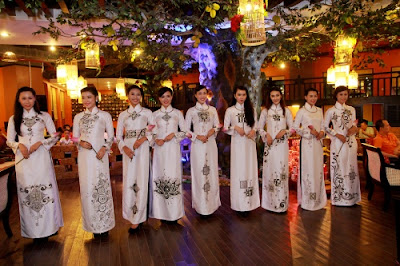
In Vietnamese, "áo dài" means "long dress". For many, the dress has become a symbol for the beauty of Vietnamese women. The áo dài began to attract international attention during the American War in Viet Nam. At that time, many Western writers, journalists, and tourists writing in French and English referred affectionately to the áo dài. Some Vietnamese terms such as: "nem", "phở" and "nước mắm" along with "Việt Minh", "Việt Cộng" and "hồ Chí Minh Trail" have appeared in Western dictionaries. Now, "áo dài" has also earned an entry. Webster's New World College Dictionary defines "áo dài" as "traditional costume of Vietnamese women, consisting of a long, high-necked, close-fitting tunic split along the side to the waist and worn over loose-fitting trousers."